
‘Bee Amazed’ by the Following Facts About Bees
- Bees have been producing honey from flowering plants for between 10 to 20 million years.
- The average honey bee only makes 1/12th of a teaspoon of honey during its lifetime.
- Bees are actually a highly specialized form of wasp.
- Bees have four wings (while flies have two).
- Most bees are fuzzy and carry an electrostatic charge, which aids in the adherence of pollen.
- The smallest bee is Trigona minima, which is about 5/64″ long (2.1 mm) and does not sting. The largest bee in the world is Megachile pluto, a leafcutter bee. Females of the species can grow to a length of 1.5” (39 mm).
- The average bee colony has approximately 60,000 bees.
- Visiting flowers can be dangerous for bees, since assassin bugs and crab spiders hide in flowers waiting to attack and capture the bees. Other bees get killed in flight by birds.
- It only takes about two tablespoons of honey to fuel a bee’s flight around the world.
- Ancient Romans had a tax season quite different to ours: They paid in honey instead of gold.
- Political theorists from Artistotle in ancient Greece to Bernard Mandeville in the 18th century to Karl Marx in the 19th century have used the bees’ society as a model for our own human networks.
- Bees go through four stages of development: First, they are cleaners. Next, they develop glands that produce royal jelly that they feed to the young larvae. Then those glands atrophy, and other glands develop and they produce thin scales of wax. These scales are released from under their abdomen, and they are used to build the cells of the hive. These glands also atrophy, and the bee becomes a general jack of all trades and guard of the hive. The final stage in their development is when they go to forage.
- Bees communicate by movement and by smell. They release pheromones and perform dances to spread information on which the colony votes.
- These insects vote on such matters as when to swarm, or which food source is best to concentrate on, and they vote by moving nearer the proposer they support.
- There is no vertical authority structure in bee colonies, and decisions are taken continuously and by democratic vote.
- The bees’ simple circular dance indicates a food source close by. A figure of eight describes food further away.
- Wiggling movements that bees make have meaning with the angle and intensity of the wiggling movements they make during the dance, indicating the direction and distance of the food or new home.
- Honey is the only substance that has all the nutrients necessary to sustain life, including water.
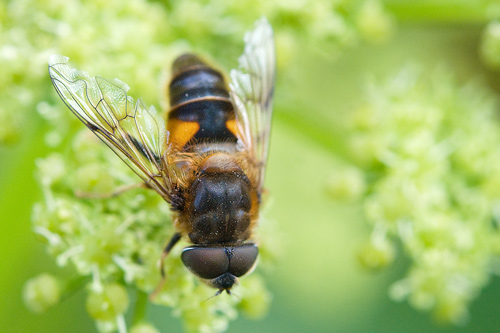
More Facts, Focusing on Honey Bees In Particular
- Honey bees have five eyes.
- They fly at about 12 miles per hour.
- A hive of bees must fly 55,000 miles to produce a pound of honey. That’s equal to more than twice around the world.
- They make their characteristic buzz from all the racket that their wings make as they stroke at 11,400 times per minute!
- Their hives are at their peak in summer when the queen bee will lay about 1,000 to 1,500 eggs per day.
- Younger honey bees learn from older and more experienced relatives how to make honey.
- On one collection trip, a honey bee will visit between 50 to 100 flowers.
- Two million flowers must be visited to create one pound of honey.
- One bee colony can make from 60 to 100 pounds of honey per year.
- Honey bees did not exist in North America until the colonists introduced them there. This is why the North American natives called honey bees ‘the white man’s fly’.
- In Central America, however, people have kept bees for centuries.
- Honey bees are scrupulous about keeping their hives as clean as possible.
Honey Bee Populations In Grave Danger
Here’s another picture – but this is one to imagine in your head and it’s a very nasty reality to comprehend, namely this: Honey bees are currently dying not just by the hundreds, or thousands, or hundreds of thousands. Rather, they are expiring by the millions.
An ecological crisis has been developing that threatens to bring global agriculture to its knees, meaning our food supplies are in grave danger.
On the Brink of Ecological Disaster?
As pollinators of crops and fruits, thirty percent of food production around the world depends on bees.
So without bees, scientists concur that an ecological disaster would occur – a possible disaster in which we are already at the crisis stage.
The Honey Bees’ Incredible Contribution to Crops
Along with pollinating flowers, bees are essential for pollinating our crops.
For example, a recent study done by Cornell University in the USA as reported in HoneyBeeQuiet.com estimated that honey bees pollinate more than $14 billion worth of seeds and crops on an annual basis in the United States.
Impressive Work: A List of What Honey Bees Pollinate
Some crops are almost entirely dependent on the honey bee for pollination (that is, 90-100% of pollination is done by them).
Here is a list of some of the crops pollinated by the honey bee (listed here in alphabetical order):
Alfalfa, almond, alsike clover, arrowleaf clover, apple, apricot, avocado, beet, blackberry, bluebells, blueberry, boysenberry, broad bean, broccoli, brussel sprouts, buckwheat, cabbage, cactus, cantalope, carambola, caraway, carrot, cauliflower, celery, cherry, chestnut, clover (not all species), coffee, cone flowers, cotton, crimson clover, crownvetch, cucumber, eggplant, flax, grape, hazlenut, honeydew, jasmine, kiwifruit, lavendar, lima bean, lupin, lychee, macadamia, mustard, okra, onion, pear, plum, quince, rapeseed, raspberry, red clover, redwood sequoia [tree], safflower, scarlet runner bean, Southeastern blueberry, rosemary, soybean, squash (plant), strawberry, sunflower, tangelo, tangerine, thyme, tomato, turnip, vetch, violets, walnut, watermelon, white clover, wisteria.
Alarming Bee Decline Is Threatening the US Food Supply
The list above shows just how vitally pivotal honey bees are to the food supply.
Therefore, because they are disappearing in vast numbers with their populations declining in such shocking numbers, the US food supply is currently endangered.
In fact, according to the University of Maryland’s College of Chemical and Life Sciences, approximately one-third of the USA’s agricultural crops is pollinated by bees.
Colony Collapse Disorder in the USA, Europe, and Southeast Asia
How have all the honey bees disappeared?
One major threat is known as ‘Colony Collapse Disorder’ (or ‘CCD’). CCD is a phenomenon in which worker bees from a beehive or European honey bee colony suddenly disappear.
Throughout the history of apiculture ( i.e., beekeeping), there have been such disappearances.
However, CCD as a term was only first applied when there was a drastic rise in the number of disappearances of honey bee colonies in North America in 2006.
In the USA, CCD been reported in more than 35 states.
European beekeepers have observed similar phenomena in Belgium, France, the Netherlands, Greece, Italy, Portugal, and Spain. Switzerland and Germany have also suffered, but at present to a lesser degree.
Possible cases of CCD have also been reported in Taiwan since April 2007.
Possible Causes of CCD
Scientists have yet to figure out the exact mechanisms that cause CCD.
However, research points to the following strong possibilities behind these catastrophic, wholesale deaths of honey bees:
- viruses (in particular, a virus known as ‘Israel Acute Paralysis Virus’ identified by Hebrew University plant virologist Prof. Ilan Sela in 2004 in which honeybees suffer from shivering wings, followed by paralysis and death outside the hive);
- malnutrition;
- pathogens;
- mites;
- fungus;
- beekeeping practices (including using antibiotics or transporting bees for long distances);
- electromagnetic radiation;
- pesticides,or more specificially, insecticides. And the neonicotinoids are front runners as a significant causative agent in colony collapse disorder.
Monoculture and the Honey Bees in the United Kingdom
The situation in the UK has been explained as follows in “Who Killed the Honeybee?”, an excellent BBC TV program that aired this spring:
Originally, many different types of bees pollinated flowers, including the 90 or so UK crops that are totally dependent on bee pollination.
However, crops became more susceptible to being damaged with the emergence of large-scale monoculture, the agricultural practice of producing or growing one single crop over a wide area.
Monoculture produces great yields by utilizing plants’ abilities to maximize growth under less pressure from other species and more uniform plant structure.
Honey Bees as Linchpins in Agribusiness
The ‘pro’ side for monoculture is that In a world with ever-growing population numbers, getting such higher crop yields has been vitally important for feeding those same populations.
As such, monoculture has been part of the post-World War II agribusiness.
However, the ‘con’ side of monoculture is that it also relies on chemical fertilizers and pesticides for the crops.
These foreign elements to nature at first killed not only a broad range of insects, but the honey bees as well.
However, pesticides were developed at that point that would target other insects – but leave the honey bees alone.
Truckin’ (What A Long, Strange Trip It’s Been)
The result of the pesticides used this way in the monoculture environment means that the only insect available to pollinate farmers’ crops is the honey bee, upon whom they now totally depend and rely.
The central importance of the honey bees to the crops is is why pollination by honey bees is not left to chance.
In fact, beekeepers transport their bees around the country in wooden crates, often piled high in huge transport trucks. The crates are carefully opened when the work destination is reached, where the bees are set free from the hives in their crates, and put ‘to work’.
Because of the farmers’ necessity for such pollination, such transporting of bees is big business for beekeepers.
Extinction in Britain of the Short-Haired Bumblebee in 1990
According to the book published in 2006 entitled Going, Going, Gone? Animals and Plants On The Brink Of Extinction And How You Can Help by Malcolm Tait, there are 270 species of bees in Britain and during the last 50 years, 10 of the species have undergone massive declines.
The bumbebee is the best known of these bees. Tait reports in his book that the short-haired bumblebee became extinct in about 1990, and about half of the social bumblebee species are in terrible straits in Britain.
Originally published 14 June 2009






 Travel Tangles
Leave a comment